


How much THC is really in weed in 2026? On labels, in forums or from your buddy, you'll quickly hear 30 percent and more. Our friends at the Institut für Hanfanalytik in Vienna wanted to know for sure and measured 534 real samples right at our booth at Mary Jane Berlin 2026. Spoiler: not a single one cracked 30%. Here are all the results.
Key takeaways:
- Median: 17.4% THC. Half of the 516 THC-dominant samples were below that, half above.
- Range: 5.9 to 25.7% THC. Not a single sample was above 30%.
- 534 samples in total: 516 THC-dominant, 13 CBD-dominant (median 10.9% CBD), 5 with notable amounts of both CBD and THC.
- Much stronger than it used to be: older European studies put the average at around 7 to 13% THC.
- Measured on site using NIR spectrometry, each sample three times.
- Not representative of Germany as a whole, because the samples were handed in voluntarily at a trade fair. But an honest look into the scene's pockets.
Quick note so there's no confusion: This isn't our study. The measurements and analysis were done by Matthias Rohm, Patricia Moser and Christian Fuczik from the Institut für Hanfanalytik (Institute for Cannabis Analytics) in Vienna, a private chemistry lab specializing in cannabinoid analysis. We just provided our booth and watched the queue in front of it get longer every day.
Mary Jane is a fixed date in our calendar every year anyway (here are the highlights from 2025). And because we found the numbers so interesting, we've summarized them for you and put them into context.
Contents:
How much THC is in weed in 2026?
The median THC content of the 516 THC-dominant samples from Mary Jane Berlin 2026 was 17.4%. The lowest value was 5.9%, the highest 25.7%. That's the key finding of the cross-sectional analysis by the Institut für Hanfanalytik.
534Samples analyzed
17.4%Median THC
25.7%Highest value
0Samples above 30% THC
ℹ️ Median? Quick explainer: Half of the samples were below it, the other half above. Unlike a regular average, the median is hardly skewed by a few extreme outliers. For an analysis like this, it's the more honest number.
How the values are spread out is interesting too. According to the study, most samples fall between about 13 and 22% THC, with values around 16 to 17% being the most common. Really weak samples under 10% were rare, and so were values above 23%.

The results at a glance.
A total of 534 samples landed on the measuring table. The lab sorted them into three groups based on their cannabinoid profile:
| Group | Definition | Samples | Result |
|---|---|---|---|
| THC-dominant | THC above 1%, CBD below 1% | 516 | Median 17.4% THC (5.9 to 25.7%) |
| CBD-dominant | CBD above 1%, THC below 1% | 13 | Median 10.9% CBD (4.5 to 16.6%) |
| CBD-THC hybrid | CBD and THC above 1% | 5 | Individual values below |
The lab listed the five hybrid samples individually. The strain names come from the participants themselves and were not verified.
| Strain (as stated) | CBD | THC |
|---|---|---|
| Tropicana Cherry | 10.6% | 7.6% |
| Himalaya | 5.9% | 6.3% |
| Apple Strudel | 8.2% | 4.0% |
| Atlas F1 | 9.6% | 9.3% |
| Unknown | 6.0% | 5.5% |
ℹ️ Why 1% as the cutoff? That's the limit of quantification of the measurement model used. Below it, the model doesn't give a reliable number. So a sample with “below 1% THC” can still contain traces.
Is 17% THC a lot? How to put the numbers in context.
Compared with the past: 17.4% is clearly above the 7 to 13% that older European studies measured on average for weed. According to the study's authors, though, the samples largely match the current level on the European market. So for 2026, it's not an outlier.
What does the EU drugs agency say?
The European Union Drugs Agency (EUDA) analyzes seized samples every year. According to the European Drug Report 2026, weed in the EU most recently (2024 data) averaged 12% THC, hashish 24.6%. Between 2014 and 2024, THC content rose by 19% for weed and by as much as 66% for hashish.
The numbers can't be compared one to one, though. The EUDA measures what was seized on the black market. At Mary Jane, visitors voluntarily brought their own samples, and where they came from wasn't recorded. The direction is still clear: weed today is much stronger than it was ten or fifteen years ago.
And what about the 30% on the label?
Not a single one of the 534 samples cracked 30% THC; the top value was 25.7%. The authors see this as a clear distinction from concentrates or specially bred high-potency strains that pop up on the market every now and then.
That fits with what the lab knows from its own analyses: actual THC content often differs from what's stated. So if someone tells you their weed has 35%, feel free to be a bit skeptical.
Is more THC better?
Not automatically. Whether you enjoy it depends just as much on terpenes, drying and freshness. And sure: more THC simply hits harder.
The EUDA counts high-potency products among the factors most clearly linked to problems from use. If you rarely smoke, you'll feel the difference between 12 and 22% very clearly. So take it slow instead of chasing percentages.
How was the THC content measured?
It was measured on site with a portable near-infrared (NIR) spectrometer. Each sample went under the device three times, and the average of the three measurements was used.
The principle, simply explained: The device shines near-infrared light onto the sample. Molecules like THC and CBD absorb very specific wavelengths. From the pattern that comes back (the spectrum), a calculation model works out the cannabinoid content.
For this to work, the model was first trained and tested with samples whose content had been determined in the lab by chromatography. Chromatography is the classic reference method in the lab, NIR the fast option for on the go.
Here's how it went at the booth:
- Strain noted, where known.
- Retrieval code handed out, so participants could look up their result online later.
- Sample photographed.
- Finely ground with an aluminum grinder so the sample is uniform.
- Filled into an aluminum weighing dish and measured three times.
- Values checked manually and uploaded to the lab server.
And what happened to the weed? Don't worry, it stayed with its owners the whole time. After the measurement, the ground material went back into a bag to take home. The lab never took or kept anything.
The device used was a MicroNIR spectrometer from the Swiss company NIRLAB AG with the data model “Cannabis Version 26”.
Why grind it first?
Because a piece of weed isn't equally potent all over. Finely ground, the sample becomes uniform, and the device measures a representative cross-section instead of some random spot.
Little bonus: evenly ground material also burns more evenly in a joint. Which grinder materials work best is covered in our grinder comparison.
Why does THC content vary so much?
There were almost 20 percentage points between the weakest and the strongest sample. There are several reasons for that:
- Genetics: The strain determines how much THC a plant can produce in the first place.
- Growing and harvest: Light, nutrients, experience and the right harvest time decide how much of it actually ends up in there.
- Drying and storage: Light, oxygen and heat break down THC over time, partly into CBN. How to slow that down is explained in How to keep your stash fresh.
- Label vs. reality: Strain names and printed values aren't a measurement. In this study, too, strain names were only asked for, not verified.
In short: The strain name points you in a direction, but only a measurement tells you the number.
Can I get my THC content tested?
Yes, most accurately in a lab. For individual analyses, the Institut für Hanfanalytik offers the CannaCheck Box, available from specialist retailers. If you want samples checked regularly (from about 30 a year), for example as a shop or cannabis club, it's best to contact the lab directly.
There are also home tests and test kits. They're handy but usually only give a rough range rather than an exact percentage. For a real number, there's no way around the lab.
Important: Check beforehand what's legal where you live. The legal situation in Germany and Austria, for example, is very different.
Does an activated carbon filter remove THC?
No. THC and CBD molecules are far too small to be held back by activated carbon or pulp. A filter catches larger particles from the smoke, like tar and soot. The cannabinoids get through. The full explanation, including the fishing net comparison, is in Do Hybrid Filters remove CBD and THC?
What that means for you: The filter doesn't change the cannabinoid content of your herbs. What it changes is the smoke around it.
And to be clear: even the best activated carbon filter doesn't make smoking healthy. It can reduce harmful substances, but it can't eliminate the risk.
⚠️ Legal notice
Updated: October 2026. This article is intended for adults and is for information purposes only. It summarizes a study by the Institut für Hanfanalytik and does not constitute medical or legal advice. The results are based on voluntarily submitted samples and are not representative of the overall market. Smoking is always harmful to your health. Filters can reduce harmful substances but cannot eliminate the risk (harm reduction). You are responsible for complying with the laws in your country.
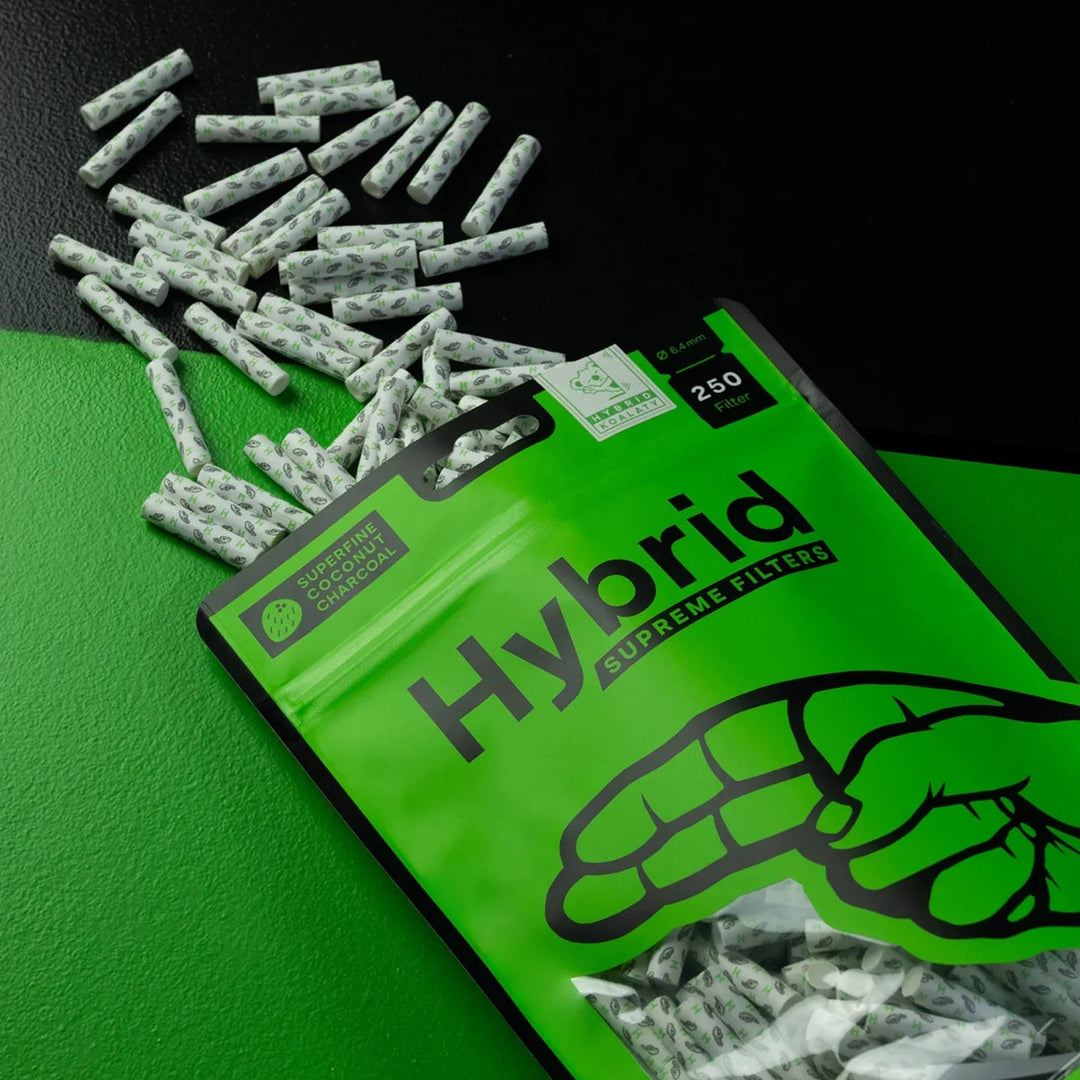
Strong weed. Clean setup.
No filter changes the THC. The smoke is another story. Hybrid Supreme activated carbon filters have a pulp fiber cap before and after the activated carbon. Lab-tested, they filter out activated carbon dust and more harmful substances than conventional filters, including nicotine. No carbon dust in your mouth, no clogging, full flavor.
FAQ: THC levels.
How much THC does weed have on average in 2026?
At Mary Jane Berlin 2026, the median of 516 THC-dominant samples was 17.4% THC. Values ranged from 5.9 to 25.7%. The measurements were taken by the Institut für Hanfanalytik from Vienna.
Is 20% THC a lot?
20% is above the median of 17.4% that the Institut für Hanfanalytik measured at Mary Jane Berlin 2026. Values above 20% did occur but weren't the norm. Compared with earlier European averages of 7 to 13%, that's considerably stronger.
What was the highest THC content measured at Mary Jane Berlin 2026?
25.7%. None of the 534 samples was above 30% THC.
How is THC content measured?
In the study, using near-infrared spectrometry (NIR): the sample is ground and measured three times, and a tested calculation model determines the content from the light spectrum. In the lab, chromatography is the reference method.
How has the THC content of cannabis in Europe changed?
It has gone up. Earlier European studies report an average of about 7 to 13% THC for weed. According to the European Drug Report 2026, the average THC content of seized weed in the EU rose by 19% between 2014 and 2024, most recently reaching 12%.
Is the study representative?
No. The samples were handed in voluntarily by trade fair visitors, and the strain names are based on their information. But the study does give a real snapshot of what the scene was smoking in 2026.
How much CBD did the CBD samples have?
The 13 CBD-dominant samples had a median CBD content of 10.9%, with values ranging from 4.5 to 16.6%. Their THC content was below 1% in every case.
Does an activated carbon filter remove THC?
No. THC and CBD molecules are too small to be bound by activated carbon or pulp. A filter reduces larger harmful particles like tar but doesn't change the cannabinoid content.
Who conducted the study?
Matthias Rohm, Patricia Moser and Christian Fuczik from the Institut für Hanfanalytik (Christian Fuczik Chemisches Labor GmbH) in Vienna. The measurements were taken during Mary Jane Berlin from June 11 to 14, 2026, at the Hybrid Supreme Filters booth.
Study and sources
- Rohm M., Moser P., Fuczik C. (2026): THC-Gehalte von Cannabisblüten auf der Mary Jane Berlin 2026. Eine Querschnittsanalyse von 534 Blütenproben. Institut für Hanfanalytik, Wien. hanfanalytik.at
- European Union Drugs Agency (2026): European Drug Report 2026: Cannabis. Lisbon: EUDA. euda.europa.eu
- Freeman T. P. et al. (2019): Increasing potency and price of cannabis in Europe, 2006-16. Addiction, 114(6), 1015-1023. doi.org
- Manthey J. et al. (2023): Public health monitoring of cannabis use in Europe: prevalence of use, cannabis potency, and treatment rates. The Lancet Regional Health Europe, 31, 100667. doi.org
- Rafiq H. et al. (2024): Non-destructive near-infrared technology for efficient cannabinoid analysis in cannabis inflorescences. Plants, 13(6), 833. doi.org
- Sánchez-Carnerero V. et al. (2025): Handheld near infrared spectroscopy for cannabis analysis: from the analytical problem to the chemometric solution. Frontiers in Plant Science, 16, 1682354. doi.org
- Mary Jane Berlin: official website, 2026 dates. maryjane-berlin.com
Share the article if it was useful:


